Asset-Managing Holding Company: GmbH or GmbH & Co. KG Compared

- An asset-managing holding company (vermögensverwaltende Holding) pools assets (shareholdings, securities and, where applicable, real estate) in a company of its own and separates them clearly from the shareholders' private assets (Privatvermögen).
- Genuine shielding of liability (Haftungsabschirmung) is offered only by the asset-managing GmbH and the GmbH & Co. KG; partnerships without a GmbH as general partner do not shield private assets.
- Particularly attractive from a tax perspective is participation income (dividends, capital gains),which is taxed considerably more favourably at the level of a GmbH than it is in private assets.
What is an asset-managing holding company?
An asset-managing holding company (vermögensverwaltende Holding) is a separate company in which private investments are pooled. Typical assets are:
- Shares in operating GmbHs
- Securities portfolios and fund participations
- Real estate
The holding company holds and manages these assets without carrying on any operating activity itself. The shareholder holds an interest in the holding company, which in turn is a shareholder in the operating companies or the owner of the assets.
A structure of this kind pursues three objectives above all:
- Structuring: A clear separation between private assets and the investment level.
- Liability: Risks arising from the shareholdings affect the holding company, not the shareholders' private assets.
- Tax: Gains from shareholdings are as a rule taxed more favourably at the level of the holding company and can be reinvested there instead of being subject immediately to the personal top rate of tax (in the case of the GmbH); losses, for example from real estate, can be offset against the shareholders' other income (in the case of the GmbH & Co. KG).
Set against these advantages is the fact that the holding company creates an additional company with its own bookkeeping, annual financial statements and tax returns.
What are the advantages and disadvantages of an asset-managing holding company?
The following expressly distinguishes between the asset-managing GmbH and the GmbH & Co. KG. Pure partnerships without a GmbH as general partner do not offer comparable shielding of liability and are therefore not considered here.
General advantages of both structures
Irrespective of the legal form, both models offer:
- Pooling & overview: The asset position can be mapped within a single structure; shareholdings, liquidity and risks are managed from one central unit.
- Scope for external management: Anyone wishing to set up a professional family office, including managers from outside the family, needs a holding company of their own as the first step.
- Deferral of taxation at private level: As long as profits remain within the structure, they are not subject to the personal rate of income tax but are taxed according to the rules of the relevant legal form; full taxation at private level applies only on distributions or withdrawals (this applies to the GmbH only).
- Succession & family structure: What is transferred in future are shares in the holding company rather than each individual asset. That makes it easier to structure succession, voting rights and assets within the family.
These advantages apply irrespective of the legal form chosen – which of the two structures is the better fit in detail depends on the following differences.
Asset-managing GmbH: advantages and disadvantages
Advantages of the GmbH:
- Limitation of liability: The shareholders' personal liability is in principle limited to their capital contribution; operating or financial risks arising from shareholdings affect the GmbH.
- Favourable taxation of participation income & reinvestment: Dividends and capital gains from shareholdings in corporations are 95% tax-exempt at the level of the holding GmbH under the participation exemption (Schachtelprivileg, § 8b KStG), so that effectively only around 1.5% corporation tax and trade tax is payable. Two different minimum shareholding thresholds apply here: for corporation tax purposes, 10% at the beginning of the year is sufficient, whereas the trade tax deduction requires a higher shareholding of at least 15% at the beginning of the collection period (§ 9 Nr. 2a GewStG). Where only the 10% threshold and not the 15% threshold is reached, the distribution does remain 95% exempt for corporation tax purposes but is subject to trade tax in full. For capital gains, by contrast, no minimum shareholding is required.
- Established, straightforward structure: A holding GmbH is a standard model in legal and tax terms with moderate complexity.
An example illustrates the effect: an asset-managing holding GmbH holds a 20% interest in an operating GmbH – so that both the 10% threshold for corporation tax and the stricter 15% threshold for the trade tax deduction are met – and receives a distribution of EUR 200,000.
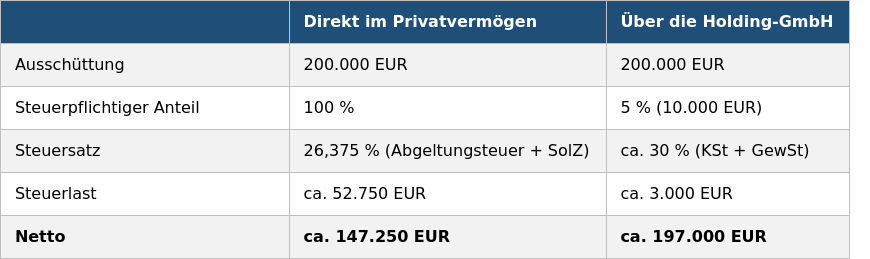
Around EUR 197,000 therefore remains within the holding company instead of EUR 147,250 in private assets – the difference is, however, only available for as long as the funds remain within the company; if they are distributed on in full to the shareholders, the overall burden again approaches that of direct taxation.
Disadvantages of the GmbH:
- Two levels of taxation: Profits are first taxed at GmbH level (corporation tax and, where applicable, trade tax) and later once again on distribution to the shareholders, either under the flat-rate withholding tax or under the partial income procedure (Teileinkünfteverfahren). The overall burden depends on how much remains in the company or is withdrawn.
- Less structuring freedom within the family group: Profit allocation and voting rights can be structured, but less flexibly than in a partnership.
- Formal obligations: Strict accounting, disclosure and resolution requirements apply, which must be complied with on an ongoing basis.
Asset-managing GmbH & Co. KG: advantages and disadvantages
In the case of the GmbH & Co. KG, the holding company is a partnership in which a GmbH acts as general partner. The shareholders typically participate as limited partners.
Advantages of the GmbH & Co. KG:
- Shielding of liability: The GmbH as general partner assumes unlimited liability; the limited partners' personal liability is in principle limited to their contribution or their registered liability amount. The desired separation of liability from private assets is thus achieved.
- High degree of structuring flexibility: The allocation of profits and voting rights can be tailored very precisely to family members, generations and different asset lines – for example by targeted control of asset rights, voting rights and distributions for different groups of partners.
- Transparent taxation at partner level: Income is attributed for tax purposes directly to the co-entrepreneurs. That allows targeted use of tax-free allowances, rate reductions or the partial income procedure, depending on the partner's profile. Losses are also attributed – of interest, for example, in real estate projects.
Disadvantages and particular risks of the GmbH & Co. KG:
- Structural and tax complexity: Infact there are two companies (the GmbH and the KG), each with its own obligations, agreements and decision-making processes. Coordinating the articles of association and the circles of partners is correspondingly more demanding.
- Special rules for limited partners: The use of losses, negative capital accounts and liability limits follow special rules which must be kept in view on an ongoing basis.
- The threshold to trading status: If the GmbH& Co. KG is to remain asset-managing, careful attention must be paid to ensuring that the structure does not in fact become trading (gewerblich). Extensive additional activities, the provision of services or "active trading" in assets can result in the company being classified as such for tax purposes – with a liability to trade tax. The boundary to trading status is a particularly important point to examine in the case of the KG.
GmbH or GmbH & Co. KG: an overview
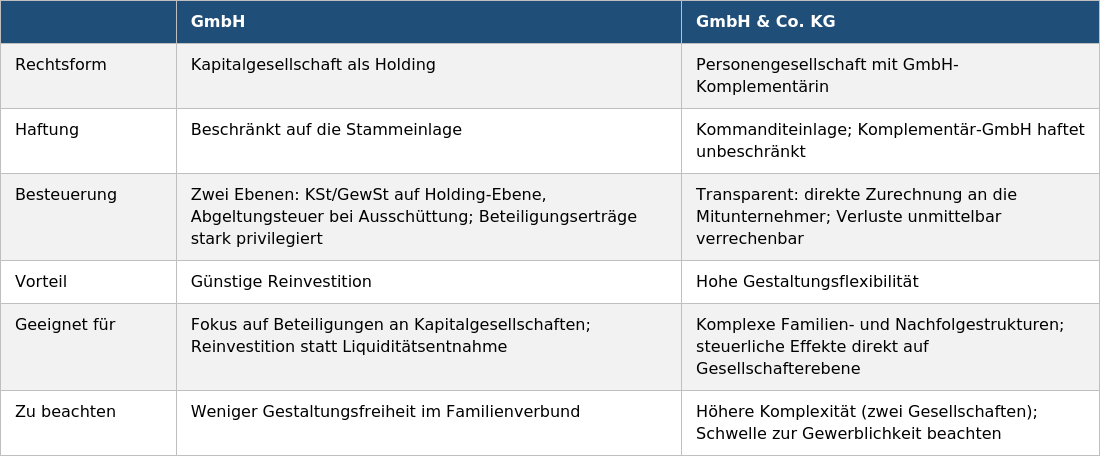
GmbH: The GmbH is particularly suitable where the focus is on shareholdings in corporations and the tax-favoured treatment of dividends and capital gains is to be used as fully as possible. Profits are to be reinvested primarily within the company, without the shareholders being dependent on continuous inflows of liquidity. At the same time, a comparatively simple, clearly structured legal form with an unambiguous separation of liability is preferred.
GmbH & Co. KG: A GmbH & Co. KG makes sense above all where more complex family or succession structures with differing allocations of profits and voting rights are to be mapped and where certain tax effects are to be used directly at partner level. At the same time, the greater complexity of the structure is accepted, together with a willingness to keep a close eye on the boundary to trading status if the KG is to remain asset-managing.
How is an asset-managing holding company formed?
The formation process can be outlined in several steps:
- Analysis and definition of objectives: First, the existing stock of assets – in particular shareholdings, securities and real estate – is recorded in full, and the objectives of the structuring, such as reinvestment, sale, limitation of liability or succession, are then clearly worked out.
- Choice of legal form and structure: In the next step the appropriate legal form for the holding company is determined, typically the decision between a pure GmbH and a GmbH & Co. KG, and on that basis the participation arrangements, the family structure and, where applicable, any foundations to be included are defined.
- Formation: The articles of association of the holding company are then drafted and notarised, registration in the commercial register is arranged, tax registration is carried out and the necessary accounts are opened.
- Contribution of assets: The existing assets – such as GmbH shares, securities accounts or real estate – are then transferred to the holding company in a tax-structured manner; at the same time, it is examined whether and in what form these contributions (Einbringungen) can be made on a tax-neutral basis or at least in a tax-optimised way.
- Organisation & compliance: Finally, the holding company's bookkeeping, reporting and annual financial statements are organised, clear rules for distributions and withdrawals are laid down and – particularly in the case of an asset-managing KG – ongoing monitoring ensures that the relevant thresholds are observed.
Häufig gestellte Fragen


.avif)
Unverbindliche Ersteinschätzung