Holding GmbH: Structure, Advantages and When It Pays Off

- A holding GmbH is a corporation that holds shares in one or more operating companies without itself being operationally active.
- The central tax advantage lies in the greatly reduced taxation of profit distributions and share sales at the level of the holding company.
- A holding company is always worthwhile where an exit is envisaged – provided that it is formed in good time before the sale, so that the tax blocking periods can expire.
- Alongside the classic GmbH holding structure, other structures may also come into consideration depending on the objective, for example a GmbH & Co. KG.
What is a holding GmbH?
A holding GmbH is a corporation whose business purpose consists in holding shareholdings in other companies. It does not appear on the market itself, or only to a limited extent, but acts as a parent company under which one or more operating subsidiaries are bundled.
- Structure: In the classic two-tier structure, the holding GmbH holds the shares in the operating company (frequently likewise a GmbH). The shareholder of the operating company is therefore no longer the private individual but the holding company. Extended structures with several subsidiaries or additional intermediate holding companies are possible where several business areas or investments are to be separated in organisational and liability terms.
- Purpose: The purpose of a holding GmbH regularly lies in the tax-optimised collection of profits and sale proceeds, the bundling of shareholdings under a single roof, and the shielding of individual business areas from one another in liability terms.
In the result, the holding GmbH is therefore purely an intermediate level between the shareholder and the operating business.
What are the advantages of a holding GmbH?
The essential advantage of a holding GmbH lies in the considerably lower tax burden on profits that remain at the level of the holding company instead of being distributed to the private individual. A distinction has to be drawn between two events here: the sale of shares in the subsidiary (exit) and ongoing profit distributions (dividends).
- Low taxation on a sale: If the holding company sells shares in the subsidiary, the gain is 95 % exempt subject to the requirements of the participation exemption (Schachtelprivileg, section 8b(2) KStG) – effectively only around 1.5 % corporate income tax and trade tax arise. No minimum shareholding quota is required for this; the exemption applies irrespective of the size of the shareholding, even at only 1 %. The following comparison shows the overall burden for a capital gain of EUR 1,000,000 across various constellations:

The table makes one thing clear: the holding advantage stands or falls with the retention of profits. As soon as everything is withdrawn, the overall burden approaches direct taxation again or even lies slightly above it – while the partial income procedure (Teileinkünfteverfahren) tends to be the most expensive variant at high personal tax rates.
- Retention in the case of dividends: The funds taxed at the low rate remain in the holding company and can be reinvested from there – for example in new shareholdings, real estate or the expansion of existing business areas. For ongoing profit distributions, however, the 95 % exemption under section 8b(1) in conjunction with (5) KStG applies only where the holding company holds at least 10 % in the distributing company at the beginning of the calendar year (section 8b(4) KStG). A stricter threshold applies for trade tax: the trade tax participation exemption (section 9 no. 2a GewStG) requires a minimum shareholding of 15 % at the beginning of the levy period. Where the shareholding lies between 10 % and 15 %, the dividend remains 95 % exempt from corporate income tax but is subjected to trade tax almost in full under section 8 no. 5 GewStG for want of a deduction – the overall burden is then around 15 % instead of only around 1.5 %. Where the shareholding is even below 10 %, it is a portfolio dividend (Streubesitzdividende), which is fully subject to corporate income tax and trade tax – the relief then falls away entirely, not merely proportionately. This aspect should be examined in advance without fail, in particular in the case of minority shareholdings or co-investments. The following comparison shows the overall burden for an ongoing profit of EUR 1,000,000 distributed by the operating subsidiary GmbH:
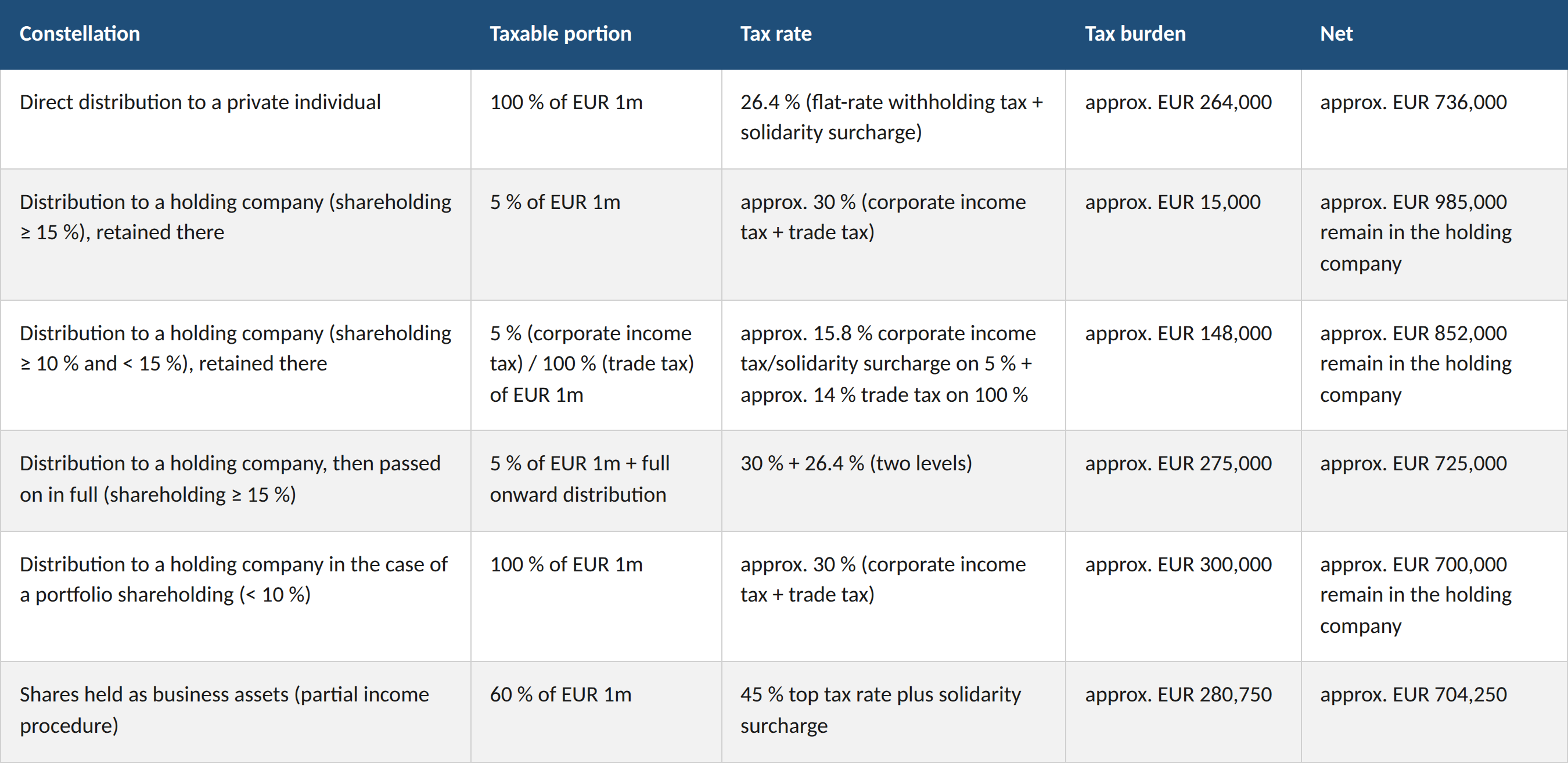
The comparison shows that the tax advantage of a holding company for ongoing distributions stands or falls not only with the retention of profits but also with the precise shareholding ratio. Between 10% and 15%, the holding company still benefits from the corporate income tax exemption but loses a substantial part of the advantage because of the higher trade tax threshold. Below the 10% threshold, the privilege is lost entirely and the burden approaches that of direct taxation.
- Disadvantages: What both tables have in common is that funds which the shareholders actually wish to withdraw privately still have to be fully taxed, and that the advantage of the holding company dissolves almost entirely where everything is distributed. In addition, the holding company creates an additional company with its own ongoing obligations – bookkeeping, annual financial statements and tax returns arise twice.
The tax leverage of a holding structure is therefore considerable, but it only takes full effect where the profits actually remain in the business and – in the case of dividends – the minimum shareholding of 15% relevant for trade tax is reached. Whether this makes sense in an individual case depends heavily on the shareholders’ own liquidity and shareholding structure.
When is a holding GmbH worthwhile?
Whether a holding GmbH pays off depends largely on whether profits are to remain in the business or be used privately, and on the volume at which the additional effort becomes worthwhile. A holding company is particularly worthwhile in the following two cases:
- Exit: A holding company makes sense in particular where the objective is itself an exit: the sale proceeds then remain 95 % tax-free in the holding company, so that considerably more capital is available for reinvestment or for building up new entrepreneurial activity than on a direct sale from private assets. This advantage applies in principle to every planned exit – irrespective of how far in the future it lies. All that matters is that the holding company is formed early enough before the actual sale, so that the tax blocking periods (see the section “What needs to be borne in mind?”) have already expired at the time of the exit.
- Reinvesting ongoing profits: A holding company is likewise worthwhile where ongoing profits are to be reinvested over several years or where several shareholdings are to be bundled under a common roof. The structure is less suitable where the shareholders depend on the liquidity in the short term: as the tables above show, accessing the money in a holding structure is not only more laborious but, where everything is withdrawn, is even disadvantageous for tax purposes compared with holding shares as private assets.
As a rough guide, forming a holding company is often worthwhile from retained profits in the mid five-figure range per year, or whenever an exit with substantial sale proceeds is planned at all and the proceeds are not to be withdrawn in full – the earlier the formation relative to the exit, the more reliably the tax advantage can be realised. The running costs of a holding GmbH – formation, bookkeeping and annual financial statements for the additional company – are usually in the low to mid four-figure range per year, depending on complexity, and should be weighed against the tax advantage.
What alternatives are there to a holding GmbH?
Alongside the classic GmbH holding structure, there are other arrangements that may make more sense depending on the objective.
- GmbH & Co. KG as a holding company: With a commercially characterised partnership (gewerblich geprägte Personengesellschaft) as the holding company, certain arrangements can be reflected more flexibly, for example as regards profit allocation and succession planning; the tax effects differ noticeably, however, from those of a corporation.
- Asset-managing holding company: Where the holding company is used exclusively to manage shareholdings and capital investments, without any commercial activity, different requirements apply to the trade tax exemption, and these should be examined carefully in advance.
- Two-tier structure: In the case of larger assets or several investors, an additional intermediate holding company can make sense in order to separate individual shareholdings or groups of investors structurally.
Which structure is appropriate in an individual case depends on the planned succession, the number of participants and the intended use of the retained profits. There is no blanket recommendation here – the choice should always be made in conjunction with the individual asset and corporate structure.
What needs to be borne in mind with a holding GmbH?
When forming and running a holding GmbH, there are a few practical points that determine the economic success of the structure.
- Timing of the formation: Where a holding company is formed only shortly before a planned sale of the operating company, tax blocking periods (Sperrfristen) may arise that can block the intended 95 % exemption for several years. The rule is therefore: it is not the temporal proximity of the exit that determines whether a holding company is worthwhile, but solely its timely formation – ideally well before concrete sale negotiations begin.
- Subsequent contribution: Where an existing operating GmbH is subsequently placed beneath a newly formed holding company, this is generally effected for tax purposes by way of a qualified share exchange (qualifizierter Anteilstausch). This process must be structured carefully in order to make it tax-neutral.
- Ongoing compliance: The additional company increases the formal obligations – from ongoing bookkeeping through the annual financial statements to the tax return. These additional costs should be budgeted realistically from the outset.
It is often precisely the right timing of the formation that determines whether the tax advantages of the holding company can actually be used in full. Obtaining tax advice at an early stage, before the formation, therefore generally pays off.
Note: the worked examples are based on an assumed overall burden of around 30% at the level of the holding company (corporate income tax plus solidarity surcharge of around 15.8% and trade tax of around 14%, without a specific trade tax multiplier) and on the flat-rate withholding tax of 26.375% or the top tax rate of 45% plus solidarity surcharge under the partial income procedure. For the constellation with a shareholding of between 10% and 15%, it has been taken into account that, in the absence of a deduction under Section 9 no. 2a GewStG, the dividend is fully subject to trade tax, while for corporate income tax only the taxable portion of 5% has been applied. The actual burden depends on the individual trade tax multiplier and on the personal tax situation.
Häufig gestellte Fragen


.avif)
Unverbindliche Ersteinschätzung