Penalties for tax evasion: what to expect – and how you should react

Key takeaways:
- Tax evasion (Steuerhinterziehung) carries a fine or a custodial sentence of up to 5 years, and 6 months to 10 years in particularly serious cases.
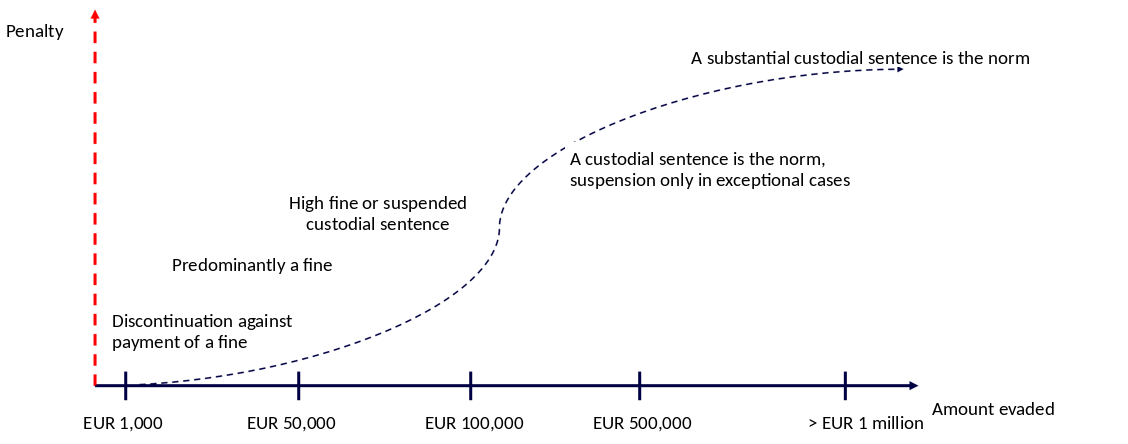
- What matters most for the sentence is the amount evaded (thresholds: EUR 50,000, EUR 100,000, EUR 1,000,000) and your conduct during the proceedings.
- An effective voluntary disclosure (Selbstanzeige) can avoid a penalty altogether.
I. What penalty does tax evasion actually carry?
The law (section 370 of the Fiscal Code, AO) provides for a fine or a custodial sentence of up to 5 years for the "ordinary" case of tax evasion (the basic offence); in particularly serious cases – for example where large amounts have been evaded or where the conduct was carefully planned – the sentencing range is 6 months to 10 years' imprisonment.
The actual level is determined by a large number of criteria. The starting point and most important criterion is, however, the amount of tax evaded, known as the amount of evasion (Hinterziehungsbetrag).
This graphic is intended to provide orientation on the basis of the thresholds developed by the case law:
Alongside the amount evaded, the further criteria relevant to sentencing are:
- A limited period of offending / no system: The shorter the period and the fewer assessment periods affected, the more readily the conduct will be regarded as a self-contained lapse – rather than a "tax model" practised over years. The period of offending is generally connected with the manner of proceeding: organised conduct that is planned and designed to last is to be classified differently from an isolated or situational act committed out of a crisis. An example: a self-employed engineer fails, on a single occasion, to declare the fee for one assignment in his tax return while he is in the middle of divorce proceedings. In case of doubt this is more likely to lead to a fine than if he had systematically feigned business expenses over years by forging subcontractors' invoices.
- No relevant previous convictions: Anyone who has already been punished for tax evasion and evades tax again runs a considerably greater risk of a custodial sentence rather than merely a fine. Someone who has already come to the attention of the criminal justice system displays (depending on the nature of the previous convictions) a "limited attachment to the law" – they appear not to take the law seriously. That weighs in aggravation, in particular in the case of relevant previous convictions (for example earlier tax evasion, white-collar crime, fraud). In constellations in which a fine would still be conceivable for a first-time offender (for example lower or medium amounts, no systematic evasion), relevant previous convictions can mean that a fine is no longer regarded as sufficient and that a custodial sentence is imposed instead (possibly suspended).
- Making good the loss: Making good the loss immediately (that is, paying the evaded tax in full, including interest and surcharges) is a mitigating sentencing factor and can tip the balance in favour of a fine in borderline cases, but under the case law its influence is clearly limited. The Federal Court of Justice emphasises in its case law that the offender is here merely settling the tax debt that they would have had to pay in any event. Payment of the tax does gain weight, however, where it went hand in hand with personal restrictions or "sacrifices" (for example the sale of assets in order to be able to pay the tax).
- Confession and cooperation: A confession is a very weighty mitigating factor and can be decisive for the question of a fine or a custodial sentence. The earlier and more comprehensive the confession, the stronger its effect. An early confession (for example early in the investigation, rather than only after being confronted with overwhelming evidence) demonstrates a genuine willingness to cooperate and saves the courts and the tax authorities considerable effort. A comprehensive confession with a full account of the facts and cooperation in establishing the amounts increases its weight as a mitigating factor still further. A late, merely partial or obviously tactical confession has a considerably weaker mitigating effect. An example: a freelance engineer failed to declare fees over several years and thereby evaded around EUR 100,000 in tax in total. During the investigation the evasion is initially vehemently denied. Only after the engineer is confronted with bank records and statements from employees does he admit the allegations. Such a confession – after denying the allegations and after being confronted with overwhelming evidence – carries considerably less weight.
- Personal circumstances: Personal circumstances can have a mitigating or an aggravating effect. These include, among other things, illness, age, inexperience in tax matters and level of education. Where an inheritance from abroad is not declared by someone who is themselves seriously ill and has no professional connection whatsoever with tax law, this is to be weighted differently from the same inheritance being concealed by a young tax adviser.
II. What further consequences does a conviction for tax evasion have?
The fine or custodial sentence is only part of the overall burden. Further financial consequences regularly follow, and these often weigh considerably more heavily than the penalty itself.
- Payment of the evaded tax : The tax office claims the underpaid tax in full – irrespective of whether a fine or custodial sentence is additionally imposed.
- Evasion interest of 6 % per year on the amounts understated: This interest is intended to offset the advantage you enjoyed from the tax not having been paid over the years.
- Late payment penalties, where tax was due and was not paid: These arise in addition to the evasion interest and serve above all as a means of pressure to ensure that tax is paid on time; in legal terms they are not interest but a kind of "surcharge for lateness".
- The surcharge under section 398a AO on a voluntary disclosure from EUR 25,000 per offence (10 %, 15 % or 20 % of the amount evaded, depending on the size of the evasion): This surcharge is an additional payment that has to be made despite an effective voluntary disclosure and is intended to ensure that larger tax evasions do not pay off economically.
- Confiscation of financial benefits: Alongside tax, interest and surcharges, the state can also confiscate assets that derive from the tax evasion or are connected with it (for example amounts saved in an account out of untaxed income); confiscation is intended to prevent you from profiting economically from the offence and therefore takes effect in addition to the penalty itself.
Possible additional consequences beyond the criminal proceedings:
- Professional consequences in certain professions (for example tax advisers, lawyers, civil servants, doctors with statutory health insurance accreditation): Alongside the criminal conviction, professional measures may follow such as disciplinary proceedings, fines, conditions or, in extreme cases, withdrawal of the licence or removal from office, because tax evasion is regarded as a breach of the special position of trust.
- Dismissal or removal of managing directors or board members where the relationship of trust has been destroyed; in practice, even the suspicion of tax evasion is enough to shake the confidence of shareholders or supervisory bodies lastingly and to justify summary dismissal or removal on the ground of a failure to set an example and to adhere to compliance.
- Reputational damage: media reports, loss of clients and business partners
III. Is a fine possible for tax evasion – and up to what amount?
A fine is possible for tax evasion. In many cases, in particular where the amounts are lower and the breach was a one-off, the proceedings end with a fine.
As regards the fine, you should bear the following aspects in mind:
- Daily rates: Fines are assessed in daily rates. One daily rate corresponds to the net income that the defendant earns in a day. At a net income of EUR 9,000, for example, one daily rate amounts to EUR 300 (EUR 9,000 / 30 days). The fine is thereby intended to reflect the economic capacity of the person convicted and to ensure that it hits everyone convicted equally hard.
- Number: The number of daily rates is based on the seriousness of the offence, the rule being that more serious conduct leads to more daily rates. Between 5 and 360 daily rates are possible. In most cases a conviction results in 30 to 90 daily rates.
- Certificate of good conduct: Not all fines are entered in the certificate of good conduct (Führungszeugnis). An entry is made only from a conviction of 90 or more daily rates.
IV. What options are there for preventing a conviction or reducing the penalty?
- Voluntary disclosure with exemption from penalty (section 371 of the Fiscal Code): Where a voluntary disclosure is made in good time and in full for all unexpired offences relating to a type of tax, and the tax is paid within the deadline together with interest, no penalty follows; the voluntary disclosure must therefore be made before the authorities have become aware of the case, for example through investigations or an audit order.
- Active repentance / making good the loss. Full and prompt payment of the evaded amount together with interest, an open confession and active cooperation in establishing the facts are treated by the courts as active repentance and noticeably reduce the penalty. In suitable cases this can even lead to the proceedings being discontinued subject to conditions, for instance against an additional payment of money or work for the public benefit.
- Keeping the amount evaded as low as possible: Every euro less can mean falling below key thresholds (EUR 50,000, EUR 100,000, EUR 1,000,000) and can thus determine whether a fine is still possible or whether a custodial sentence is already in prospect, and whether that sentence can be suspended. A careful examination is therefore worthwhile.
- Procedural strategy: Solutions based on procedural strategy aim to limit the risk of a high penalty and, as far as possible, to achieve a discreet disposal. Frequently a discontinuation under sections 153 and 153a of the Code of Criminal Procedure (StPO) subject to conditions, a penalty order instead of a public main hearing, or a solution based on a negotiated agreement comes into consideration, making the sentence and the course of the proceedings predictable.
Political developments: There is currently discussion about restricting the exemption from penalty afforded by voluntary disclosure where large amounts are involved; to date (as at May 2026), however, no legislative amendment is in force, so the existing legal position continues to apply
V. What are the requirements for tax evasion – and when is there "merely" a reckless understatement of tax?
Tax evasion under section 370 AO exists where someone makes incorrect or incomplete statements to the tax office, conceals facts of tax relevance, or fails to use prescribed tax stamps or seals, and where this results in an understatement of tax or in unjustified tax advantages. What is decisive is that this happens intentionally. Conditional intent (bedingter Vorsatz) is sufficient: anyone who reckons that their statements are probably incorrect but "accepts this" is already acting intentionally in law. Even an attempt at tax evasion is punishable, that is, it is enough for someone to take steps towards an evasion, even if the result ultimately fails to materialise.
In practice, tax evasion shows itself for example where income is deliberately not stated in the tax return, such as rental income from a privately let flat or fees regularly received in cash. Also typical is deliberate "optimisation" with the thought "the tax office won't notice", for instance by declaring private living costs as business expenses although it is clear that these are not deductible under the law. Also covered are cases in which prescribed tax stamps or seals, such as may be provided for in the area of excise duties, are deliberately not used in order to save duty. An example: an importer has high-proof spirits (for example whisky or vodka) brought into Germany from a third country and sells these drinks here without affixing or using the prescribed tax stamps. In this way the alcohol duty under the Alcohol Duty Act (AlkStG), that is, the excise duty on potable alcohol, is deliberately not paid.
Set against this is the reckless understatement of tax under section 378 AO. Here too tax is understated, but not intentionally; rather it results from heightened negligence, known as recklessness (Leichtfertigkeit). This means that the taxpayer disregards the required care to a particularly high degree, without however consciously accepting that their statements are incorrect. The legal consequence in these cases is "merely" an administrative fine, in principle of up to EUR 50,000 and in special cases up to EUR 100,000; no custodial sentence is possible here.
Typical constellations of a reckless understatement of tax are found in confusing or complex tax situations, for instance where someone acts without tax advice and misunderstands the complicated rules on foreign shareholdings or cross-border activities. One example is the self-employed person who, on the basis of contradictory information from the internet, treats certain income as tax-free although, on a careful examination or after consulting a tax adviser, they could have recognised that it was in fact taxable. In such cases there is often no deliberate "eyes shut and carry on" attitude, but a clear breach of the duty of care that nevertheless remains below the threshold of intent.
The distinction between intentional tax evasion and reckless understatement of tax is one of the decisive points of attack in a criminal tax defence. It determines to a large extent whether criminal investigation proceedings with the possibility of a fine or custodial sentence are conducted, or whether "only" administrative fine proceedings are in prospect. In addition, classification as tax evasion or as a reckless understatement has consequences for the limitation period under tax law: for tax evasion this generally extends to up to ten years, whereas for a mere reckless understatement a shorter period of five years regularly applies.
Frequently Asked Questions


.avif)
No-obligation initial consultation