Voluntary disclosure to the tax office: securing exemption from penalty for tax evasion

Key takeaways:
- With an effective voluntary disclosure (Selbstanzeige) you can avoid criminal prosecution for tax evasion.
- A voluntary disclosure takes effect only where it reaches the tax office in good time, in full and in the correct form; errors carry the risk of fines or custodial sentences despite the disclosure.
- Tax proceedings and criminal proceedings are separate: you have to pay the evaded tax, the interest and any surcharges in full.
I. What is a voluntary disclosure to the tax office?
A voluntary disclosure makes it possible to prevent a conviction despite tax evasion having been committed. It is the central instrument for clearing up tax evasion that has already taken place, from a criminal law perspective. You disclose all previously undeclared facts of tax relevance and tax bases for all the types of tax and assessment periods concerned – retrospectively for 10 years. In return you obtain exemption from penalty. Important: a voluntary disclosure cannot be corrected – everything must therefore be disclosed correctly and in full "in one go". An ineffective voluntary disclosure will in case of doubt lead to a more lenient penalty, but it does not provide exemption from penalty.
II. What are the consequences of an effective voluntary disclosure?
Where the voluntary disclosure is effective, criminal liability for tax evasion falls away for the matters covered. Alongside the penalty itself, the measures that may accompany an investigation (searches of premises, seizures, and so on) also fall away.
From a criminal law perspective the matter is thereby conclusively settled. Nevertheless you have to pay the evaded tax, the interest and any surcharges in full:
Alongside the tax itself, interest and surcharges generally arise as well. Evasion interest of 6 % per year is charged on the amounts evaded, under section 235 in conjunction with section 238 of the Fiscal Code. In addition there may be a surcharge in favour of the public purse under section 398a(1) no. 2 of the Fiscal Code: this amounts to 10 % of the amount evaded up to EUR 100,000, 15 % where the amount evaded is more than EUR 100,000 and up to EUR 1,000,000, and 20 % where it exceeds EUR 1,000,000. Because of this interest and these surcharges, the total amount payable to the tax office is considerably higher than it would have been if the tax had been declared and paid correctly from the outset.
III. What are the consequences of an ineffective voluntary disclosure?
An ineffective voluntary disclosure has no exempting effect, but at the same time provides the authorities with detailed information about the offence.
Typical consequences of an ineffective voluntary disclosure:
- Where a voluntary disclosure is classified as ineffective, criminal proceedings are generally continued or initiated. The person concerned is then prosecuted for tax evasion according to the general standards; the legal consequences that come into consideration are a fine or – depending on the seriousness of the case – a custodial sentence.
- The disclosure of the facts of tax relevance made in the context of the ineffective voluntary disclosure can nevertheless have a mitigating effect, even though it does not confer exemption from penalty. The court can take that disclosure into account in the defendant's favour when determining the sentence. The rule is, however: the later and the less complete the information given in the ineffective voluntary disclosure, the smaller this mitigating effect is in practice.
- The ineffectiveness of the voluntary disclosure changes nothing as regards the tax burden. The evaded tax is collected by the tax office regardless. This in principle also includes the assessment of interest, so that the overall tax burden remains in place even where the level of any penalty is still to be decided.
The main reasons for a voluntary disclosure being ineffective are:
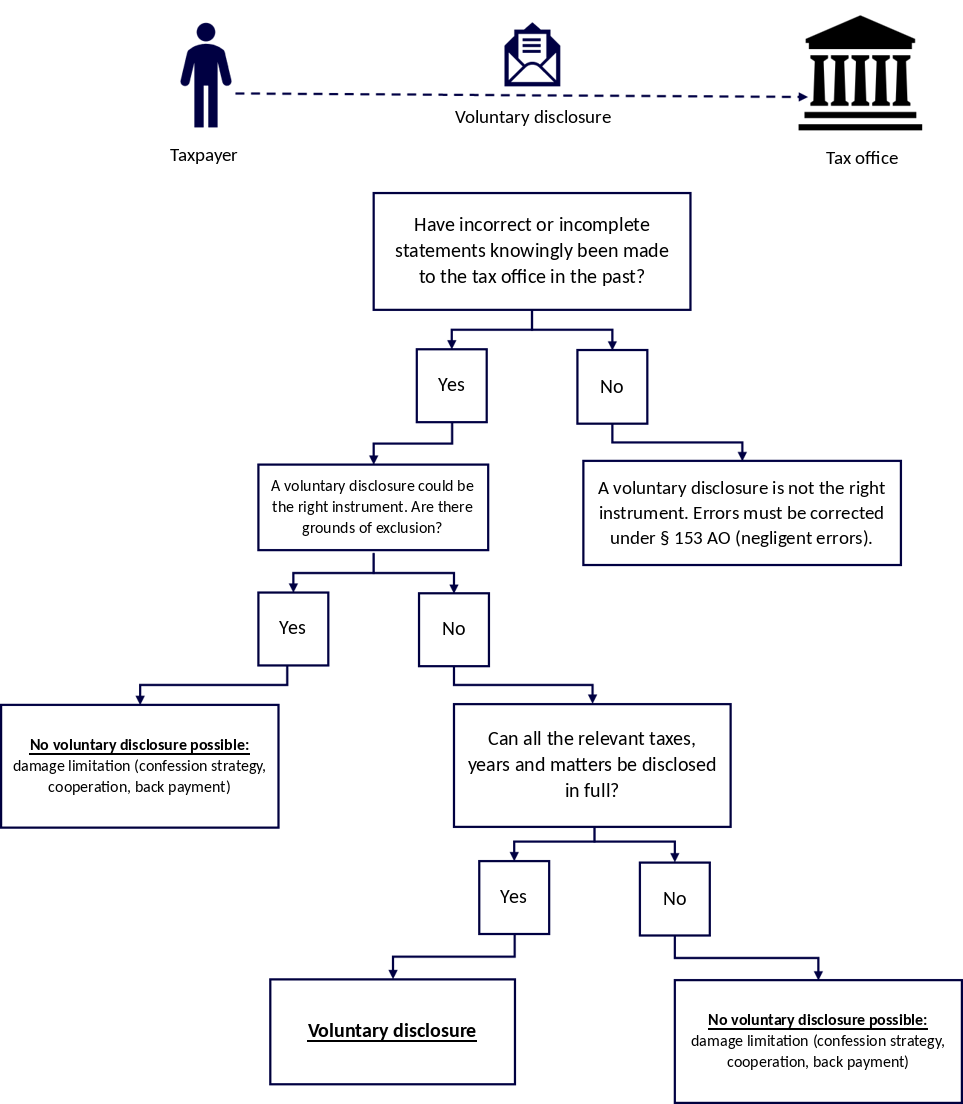
- Grounds of exclusion under section 371(2) AO: Put simply, a voluntary disclosure is always barred in constellations in which the legislature assumes that the disclosure is no longer being made voluntarily but out of a position of constraint. That is the case in particular where the tax office has already notified an audit order for the types of tax and periods in question before the voluntary disclosure was made, or where the offence has already been discovered, or where the person concerned has been notified that criminal or administrative fine proceedings have been initiated. In these situations it is apparent to the taxpayer that the matter is already the focus of the tax authorities' attention. Because the return to tax honesty is then – in the legislature's view – no longer voluntary, the voluntary disclosure no longer has any exempting effect.
- Incompleteness or defects in content: A voluntary disclosure is incomplete in particular where not all the types of tax or assessment periods concerned are disclosed. It is problematic, for example, where only certain years, or only income tax, are re-declared while corresponding VAT or corporate income tax returns remain unchanged although evasion has occurred there too. It is equally critical where individual accounts – above all foreign or numbered accounts – or particular sources of income or arrangements are deliberately not mentioned. That can be the case, for example, where only domestic interest income is disclosed while income from a foreign account or from a foreign shareholding remains concealed. Finally, the voluntary disclosure may also be insufficient because the information given is so imprecise or patchy that the tax office cannot assess the tax properly. That concerns, for instance, constellations in which there is general reference to "capital income abroad" but neither specific amounts, periods, accounts nor banks are named, so that a comprehensible and legally secure retrospective taxation is not possible.
Important: In cases in which an effective voluntary disclosure is no longer possible, the task is regularly to limit the sentence through early cooperation, full back payment and a coordinated defence strategy.
IV. How must the voluntary disclosure be made?
The voluntary disclosure must satisfy strict formal and substantive requirements in order to be effective. It must be drafted in such a way that the tax office is able to assess the tax correctly without carrying out further investigations of its own. This includes, first, that the person or company making the voluntary disclosure is fully identified, that is, that the individual, the GmbH or a tax group is unambiguously named with its respective details. In addition, the types of tax concerned must be specifically identified, for example income tax, corporate income tax, VAT or inheritance tax. A clear list of the years or assessment periods concerned is likewise required, so that the tax office can see for which periods a correction is to be made.
The heart of the voluntary disclosure is the precise re-declaration of the previously undeclared income, turnover or other tax bases. These must be presented in a numerically comprehensible form, for instance by specific amounts per year and source of income, so that the evaded tax can be calculated.
Finally, meaningful documents and evidence should be attached. These typically include account and securities statements, contractual documents, internal calculations or detailed schedules of cash turnover.
The further requirements can be summarised as follows:
- Competent tax office: The addressee is the tax office responsible for your taxation. In complex matters, communication frequently takes place additionally with the fines and criminal matters unit of the tax authorities.
- Form of submission: The voluntary disclosure is generally submitted in writing (a letter with annexes; a fax is in principle possible) or by electronic transmission, for example via ELSTER or the secure transmission channels of a tax adviser. Submission by record at the tax office is also legally permissible but, given the typical complexity, is rarely the practical option.
- Timing and deadlines: There is no deadline for making a voluntary disclosure; what is decisive is that it reaches the tax office before a ground of exclusion arises. Anyone who receives indications of an impending tax audit, a control notification or data evaluations (for example from banks) should take the time factor particularly seriously.
Practical guidance from our advisory experience
A hurried and therefore incomplete voluntary disclosure is in practice frequently more dangerous than a declaration submitted a few days later but carefully prepared. Errors, gaps or inconsistent information can mean that the voluntary disclosure loses its exempting effect while at the same time producing incriminating material.
A staged approach is therefore generally sensible. First, the relevant documents should be secured quickly, for example account statements, contracts, accounting records or internal overviews. On that basis a rough initial tax estimate can then be made in order to assess the scale of the problem and the likely amount to be paid. A self-contained, arithmetically checked voluntary disclosure is then drawn up in which all matters are re-declared in a structured and complete manner.
Communication with the tax office should always be documented in writing, for example through letters on file, emails or notes of conversations. The content and tone of that communication should also be aligned with the overarching defence strategy, so that the tax corrections and the criminal law assessment are consistent and no unnecessary risks are created.
Put very simply, the decision-making process can be represented graphically as follows:
V. Are advisers worthwhile in a voluntary disclosure for tax evasion?
Given the considerable criminal and financial risks, a voluntary disclosure without qualified advice is a high-risk project. Even isolated omissions (such as an overlooked account or an assessment period left out of account) can cause the exempting effect to fall away entirely.
It is frequently assumed that supposedly small amounts "do not matter". In practice, however, adding together several years each with smaller amounts evaded quickly produces considerable overall sums – with a corresponding risk of criminal liability and noticeable financial consequences. Another widespread misconception is the belief that the matter can be "settled informally with the case officer". Individual tax officials are, however, strictly bound by tax and criminal law; personal or "accommodating" arrangements offer no reliable protection against later prosecution. Equally mistaken is the assumption that advice costs more than it brings in. Compared with possible fines or custodial sentences, potential reputational damage and operational consequences, the cost of qualified professional advice is generally money well spent.
Frequently Asked Questions


.avif)
No-obligation initial consultation