Setting Up a Holding Company: Formation and Running Costs at a Glance

- The pure formation costs of a holding GmbH are usually in the range of EUR 1,500 to 3,500, plus the legally required share capital contribution of at least EUR 25,000.
- The ongoing costs for bookkeeping, annual financial statements and tax returns for the additional company are usually in the range of EUR 2,000 to 6,000 per year.
- There is an important difference between the capital contribution itself (which remains within the company's assets) and the actual, sunk costs for the notary, the commercial register and advice.
- The type of holding structure noticeably affects the cost structure: a UG can reduce the entry costs, whereas a GmbH & Co. KG raises them considerably because of the two-tier corporate structure.
How high are the costs of setting up a holding company?
For the formation of a classic holding GmbH you should reckon with pure formation costs of around EUR 1,500 to 3,500, plus the legally required share capital contribution of at least EUR 25,000. For more complex structures such as a GmbH & Co. KG, the formation costs are correspondingly higher because two companies have to be formed, whereas a UG as a holding form can reduce the entry costs.
Important to understanding the overall costs is the distinction between two fundamentally different components:
- Capital contribution: The share capital contribution (Stammeinlage) (at least EUR 25,000 in the case of a GmbH, of which at least half must be paid in immediately where the company is formed with cash) is not a sunk cost but remains within the company as its assets. It continues to be available to the holding company, for example for investments or as liability capital, and in economic terms "costs" the founder nothing in the strict sense.
- Ongoing versus formation costs: The actual costs are divided into one-off formation costs (notary, commercial register, advice) and ongoing costs, which arise annually throughout the entire existence of the holding company. Both cost blocks should be considered separately when deciding on a holding structure, because they are economically different in character.
How high are the formation costs of a holding company?
The formation costs of a holding company are made up of several individual items that vary according to the complexity of the structure.
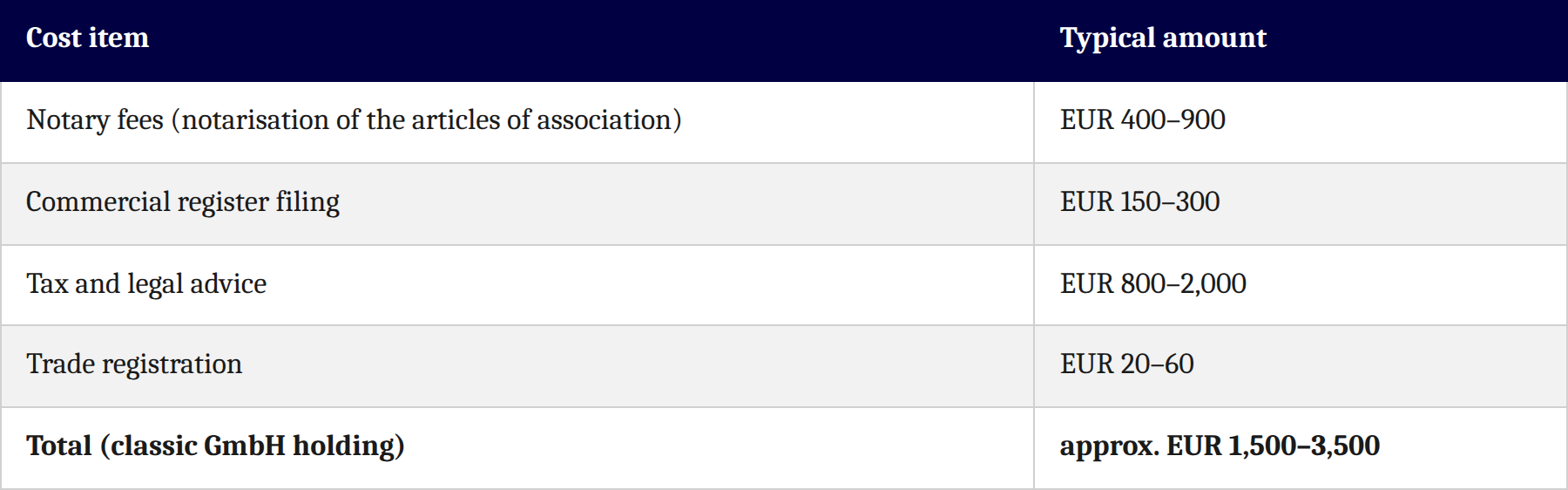
Assumptions: the costs relate to a straightforward cash formation of a single-member holding GmbH with a standard articles of association; individual advisory services (for example on the contribution of an existing GmbH) can increase the costs.
As regards the advice item, it should be noted that the advisory effort can increase considerably where there are several shareholders. As soon as more than one person holds an interest in the holding company, additional questions regularly arise that require advice going beyond the mere accompaniment of the formation – for example governance arrangements (shareholders' meeting, consent requirements, non-compete clauses), disproportionate profit distributions (that is, distributions deviating from the participation quota), vesting clauses for shareholders who build up their shares only over time, or arrangements for the departure of a shareholder (exit and drag-along/tag-along clauses). Where there are several shareholders, several thousand euros should therefore realistically be budgeted in addition for advice, rather than the range stated above for a single-member formation.
UG instead of GmbH as the holding company: anyone wishing to reduce the entry costs can also form the holding company as an entrepreneurial company with limited liability (Unternehmergesellschaft (haftungsbeschränkt)). For a UG, share capital from as little as EUR 1 is legally sufficient, which considerably reduces the capital to be provided immediately – the pure formation costs for the notary and the commercial register are similar to those for a GmbH. In practice, share capital of at least EUR 500 is often recommended so that the initial costs can be met. In return, there is a statutory obligation to allocate at least 25 % of the profit to a reserve each year until the capital reaches the GmbH minimum of EUR 25,000 – the UG is therefore more of an entry-level model for formations with less capital than a permanently cheaper alternative, since the ongoing costs for bookkeeping and annual financial statements are identical to those of a GmbH.
With a GmbH & Co. KG as the holding structure, the formation costs largely double, because two companies – the general partner GmbH and the KG itself – have to be formed and notarised or registered in the commercial register. Total costs of around EUR 3,000 to 6,000 should be expected here, with the share capital of the general partner GmbH (at least EUR 25,000) coming on top, while no statutory minimum capital is prescribed for the KG itself.
For tax purposes, the formation costs are in principle expenses of the shareholder that increase its acquisition costs for the shareholding; in tax terms they regularly have a value-reducing effect only on a later sale of the shares. Where the articles of association expressly regulate the amount and the type of costs assumed in connection with the formation, the company can assume up to around 10 % of the formation costs as its own business expense. If the articles contain no such provision, the assumption of the formation costs by the company constitutes a hidden profit distribution (verdeckte Gewinnausschüttung). The precise classification of the individual cost items should be examined from a tax perspective in advance, since differences can arise here depending on the structure.
What ongoing costs does a holding company incur?
In addition to the one-off formation costs, every holding company incurs ongoing, annually recurring costs throughout the entire life of the company.
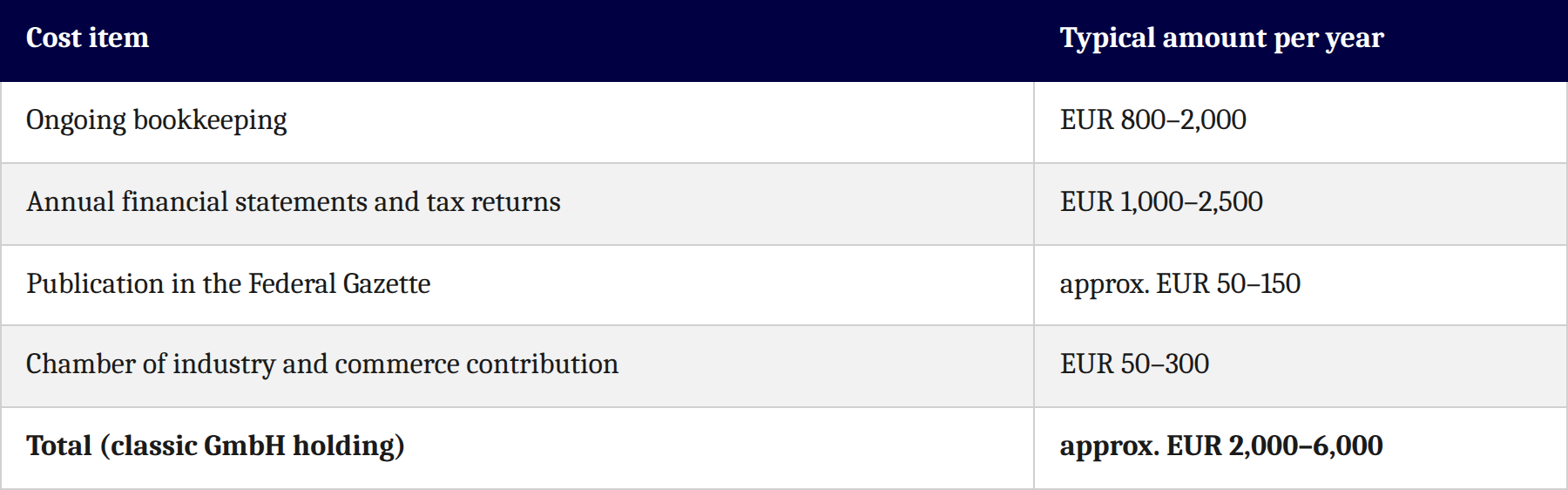
Assumptions: the costs relate to an asset-managing single-member holding GmbH with a manageable transaction frequency; where business activity is more extensive, where there are several shareholdings or where a statutory audit is additionally required, the costs rise accordingly.
The level of the ongoing costs is determined largely by several criteria: the number and complexity of the shareholdings held, the volume of business transactions (for example the number of entries per year), the question of whether a statutory audit becomes necessary under the size-dependent thresholds of the Commercial Code (HGB), and the tax adviser chosen and their fee structure. With a GmbH & Co. KG structure, the ongoing costs for both companies are added together, so that 1.5 to 2 times the figures stated should regularly be expected here, because separate financial statements and returns are required for the general partner GmbH and for the KG. For a UG, the ongoing costs for bookkeeping and annual financial statements arise at the same level as for a GmbH, since both legal forms are subject to the same obligations under commercial and tax law.
Frequently Asked Questions


.avif)
No-obligation initial consultation