Appealing against assessments issued after a tax audit: what businesses need to know

Key takeaways:
- A tax audit frequently ends with amended tax assessments – an appeal can be lodged against these within one month.
- An appeal is always worthwhile where the tax office has made errors in establishing the facts or in the legal assessment.
- The appeal can be lodged free of charge and is required for any later proceedings before the tax court.
- Without an appeal lodged in good time, the assessment becomes final and can no longer be challenged.
I. What is an appeal in the context of a tax audit?
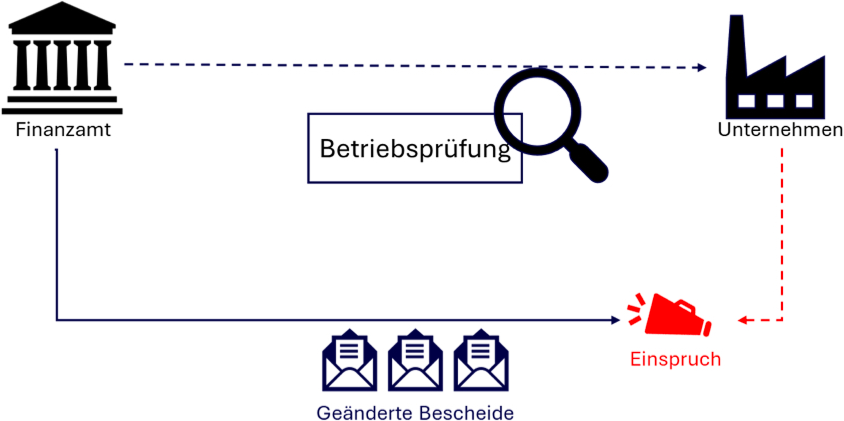
An appeal gives businesses the opportunity to defend themselves against decisions of the tax office in the context of a tax audit (Betriebsprüfung). What is examined is in particular the accounts, receipts, contracts and account movements. At the end of the audit the results are summarised, frequently in a closing meeting. On that basis the tax office issues amended or first-time tax assessments in which, for example, additional profits are estimated or certain expenses are not recognised.
An appeal is the legal remedy provided for by law against such tax assessments.
- Purpose of the appeal: The appeal challenges the substantive correctness of the assessment.
- Form & time limit: The appeal must in principle be lodged in writing and is subject to a time limit (regularly one month from notification of the assessment).
- Example of application: It comes into consideration in particular where the business takes the view that the facts have been established incorrectly (for example deposits wrongly treated as taxable turnover) or that tax provisions have been applied incorrectly (for example supplies wrongly treated as subject to VAT).
In the appeal procedure, a different unit within the tax office reviews the assessment afresh. The business can give reasons for its objections and submit further documents. The tax office can then amend the assessment in the taxpayer's favour (allow the appeal), leave it unchanged or adjust it only in part. If the appeal is rejected in whole or in part, there is then the possibility of bringing proceedings before the tax court. The appeal is therefore the central first step towards having the results of a tax audit reviewed and corrected in law.
II. When should an appeal be lodged after a tax audit?
An appeal always makes sense where the assessment issued after the tax audit is incorrect.
In practice the following constellations are frequent:
- Incorrect establishment of the facts: The tax office has established the facts incompletely or incorrectly. A typical example: large cash deposits made by a freelancer out of savings are treated by the tax office as undeclared business income, although they are in fact capital contributions.
- Incorrect estimates: The tax office estimates the tax bases (section 162 of the Fiscal Code) and in doing so breaches the principles governing estimates. A breach typically exists where the tax office
- adjusts only turnover and stock to the business's detriment,
- does not also estimate business expenses, staff costs and overheads,
- ignores cost structures typical of the sector and valuation problems (stock, work in progress),
- or fails to provide a coherent, economically plausible and comprehensible derivation.
- Errors of law: The tax office applies a tax provision incorrectly or misapprehends the case law of the highest courts. A typical example: the blanket classification of supervisory board members as entrepreneurs within the meaning of section 2(1) of the VAT Act, irrespective of the remuneration risk.
- Formal errors: The assessment is not correctly addressed, contains no information on legal remedies or incorrect information, or suffers from another defect in notification.
- Limitation questions: The assessment is issued although the limitation period for assessment has expired. A tax audit does suspend the running of the assessment period under section 171(4) AO – but only where it has actually begun and has not been interrupted for an unreasonably long time.
III. How must the appeal be lodged?
The appeal must be lodged in the correct form and within the time limit. The competent tax authority examines both carefully; if one of the requirements is missing, the appeal is rejected as inadmissible.
- Time limit
- The appeal must be lodged within one month of notification of the tax assessment (section 355(1) AO).
- Where the assessment is sent by post, the four-day rule of section 122(2) no. 1 AO applies: the assessment is deemed to have been notified on the fourth day after it was posted – if that day falls on a Saturday, Sunday or public holiday, it moves to the next working day.
- Note: Where the assessment contains no information on legal remedies at all, or incorrect information, the appeal period is extended to one year (section 356(2) AO). Anyone who misses the deadline through their own fault can apply for restoration to the previous position (section 110 AO) – but only in the absence of fault, which is examined strictly.
- Form
- The appeal is not subject to any particular form, but must make it unambiguously clear that the taxpayer is challenging the assessment. Permissible forms are:
- In writing (letter, fax)
- Electronically (for example via ELSTER or the special electronic mailbox for tax advisers)
- By record at the tax office
- Not sufficient: a telephone indication that the assessment is incorrect, or a declaration by implication, does not suffice.
- The appeal must contain at least:
- the name and address of the sender
- identification of the contested assessment (type of tax, assessment period, date)
- a recognisable declaration of the intention to appeal
- The appeal is not subject to any particular form, but must make it unambiguously clear that the taxpayer is challenging the assessment. Permissible forms are:
Example:
„I hereby lodge an appeal against the corporate income tax assessment for 2022 dated 15 April 2026.”
- Reasons
- There is no obligation to give reasons, but reasons are strongly recommended.
- Well-founded reasons increase the prospects of success considerably.
- The tax office can also set a deadline for stating the relevant facts and evidence (section 364b AO); explanations and evidence submitted only after that point may in certain circumstances no longer be taken into account.
IV. How does the appeal procedure run?
On receipt of the appeal, the tax office first examines its admissibility (form, time limit, adverse effect). If the appeal is admissible, the examination of the substance follows: the tax office reviews the assessment in full – including in the appellant's favour.
The procedure ends either with:
- Allowing the appeal: The tax office upholds the appeal and issues an amended assessment.
- Partially allowing the appeal: The appeal is regarded as well-founded in part. –
- A decision on the appeal: The tax office rejects the appeal as unfounded or dismisses it as inadmissible.
Next steps after a rejection: If the appeal is rejected by a decision on the appeal, proceedings before the tax court can be brought within one month. The appeal procedure must be conducted as a mandatory preliminary procedure.
The duration of the appeal procedure varies greatly – from a few weeks to several years, in particular where fundamental questions of law are open.
Important for liquidity: An appeal against an assessment issued after a tax audit likewise has no suspensive effect. Back payments arising from the tax audit therefore remain due. To avoid liquidity shortages, an application for a suspension of enforcement (section 361 AO) should be made at the same time. This presupposes that there are serious doubts as to the lawfulness of the assessment or that enforcement would constitute an inequitable hardship.
V. What is a tax audit?
The external tax audit (Betriebsprüfung) is an examination carried out by the tax office at the company's premises, in which the tax position for past assessment periods is examined. It is initiated on the basis of an audit order (section 196 AO) and formally begins as soon as the auditor takes specific investigative steps after notification of the audit order.
The key points of a tax audit at a glance:
- Persons affected: In principle all taxpayers with profit income – particularly frequently corporations and larger partnerships (by size category under the audit regulations).
- Period: As a rule the last three to five years, and longer where there are grounds for suspicion.
- Duties to cooperate: The business is obliged to provide information, submit documents and grant access to its IT systems (sections 200 and 147 AO).
- Closing meeting: Before the amended assessments are issued, a closing meeting generally takes place at which the audit results are discussed – an important moment for influencing the outcome.
- Suspension of the assessment period: An ongoing tax audit suspends the running of the assessment period under section 171(4) AO – but only where the audit is not interrupted for an unreasonably long time.
How we can advise you
Tax assessments issued after a tax audit are by no means the last word. Businesses that disagree with the outcome should act quickly: the one-month appeal period runs from notification of the assessment. It is also decisive to apply at the same time for a suspension of enforcement, in order to avoid liquidity shortages caused by impending back taxes.
We support you in reviewing the results of a tax audit on a sound legal basis, formulating a convincing appeal and – where necessary – taking the matter to the tax court.
Frequently Asked Questions


.avif)
No-obligation initial consultation