Setting Up a Holding Company with an Existing GmbH: Routes, Process and Tax Pitfalls

- A holding company with an existing GmbH is typically set up by the current shareholders (Gesellschafter) contributing their GmbH shares to a newly formed holding company.
- The holding structure offers, in particular, tax relief on the sale of the operating GmbH, better structuring of assets and risk, and flexible arrangements for reinvestment and succession.
- For a tax-neutral contribution (steuerneutrale Einbringung), the decisive factors include a blocking period (Sperrfrist) running over several years, the choice of the appropriate legal form (usually a GmbH) and careful contractual and tax structuring.
How can a holding company be set up where a GmbH already exists?
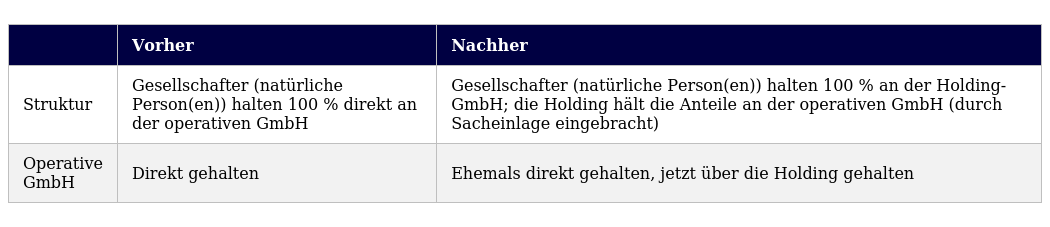
Setting up a holding company with an existing GmbH is regularly achieved in practice by the shareholders (Gesellschafter) forming a new company (the holding company) and contributing their shares in the existing operating GmbH to that holding company. The shareholding (Beteiligung) previously held directly is thereby converted into a shareholding held via the holding company.
In essence there are three routes of practical relevance:
- Formation of a new holding GmbH followed by contribution of the GmbH shares: First, the current shareholders form a new GmbH (the holding company) as the parent entity. They then contribute their shares in the existing operating GmbH to the holding company as a contribution in kind (Sacheinlage) and receive shares in the holding company in return. For tax purposes this contribution can – where properly structured – be made at book value (Buchwert), that is, without immediate taxation of hidden reserves, provided the requirements of reorganisation tax law (Umwandlungssteuerrecht) are complied with (in particular the blocking periods (Sperrfristen)).
- Contribution to an existing corporation acting as the holding company: Where the shareholders already hold an interest in another corporation (Kapitalgesellschaft), that company can act as the holding company by having the GmbH shares contributed to it. In economic terms the structure is similar to forming a new company; what matters are the valuation, the contribution agreement and the carrying over of book values for tax purposes.
- Contribution to a holding partnership (for example a GmbH & Co. KG): In certain constellations a partnership (Personengesellschaft), frequently a GmbH & Co. KG, can be used as the holding company instead of a pure corporation. This variant produces different income tax effects (transparency, in part preferential tax rates), but is more complex and should only be chosen after specific planning.
In practice, setting up a holding company with an existing GmbH is predominantly implemented by forming a new holding GmbH followed by a contribution in kind of the GmbH shares, because this structure is well established for tax purposes and readily manageable in legal terms.
Overview of the structure before and after
What are the advantages of setting up a holding company?
Setting up a holding structure brings – where properly arranged – several key advantages:
- Tax relief on disposals and distributions: Where the holding company sells the operating GmbH, capital gains are to a considerable extent tax-exempt at the level of the holding GmbH (the 95% exemption under § 8b KStG); effectively, profits bear corporation tax (Körperschaftsteuer) and trade tax (Gewerbesteuer) only to a small extent. Where the operating GmbH distributes profits to the holding company, dividends are likewise largely tax-exempt, while full taxation predominantly arises only on distribution to the private shareholders.
- Better structuring of assets and risk: Surpluses from the operating business (for example sale proceeds, profits not required in the business) can initially be 'parked' in the holding company on a tax-privileged basis instead of passing straight into private assets (Privatvermögen). Assets can moreover be shielded from operational risks within the holding company – for instance by separating the operating GmbH from an asset-holding or property-holding company.
- Flexibility for reinvestment and succession: Profits and sale proceeds can be reinvested in new shareholdings within the holding company without full income tax (Einkommensteuer) first arising at shareholder level. For succession and participation models (for example bringing in investors, management participations, step-by-step transfer to the next generation), the holding company offers a structured level for share transfers and voting rights arrangements.
An example illustrates the tax effect on a disposal: the holding company sells the operating GmbH at a capital gain of EUR 800,000.
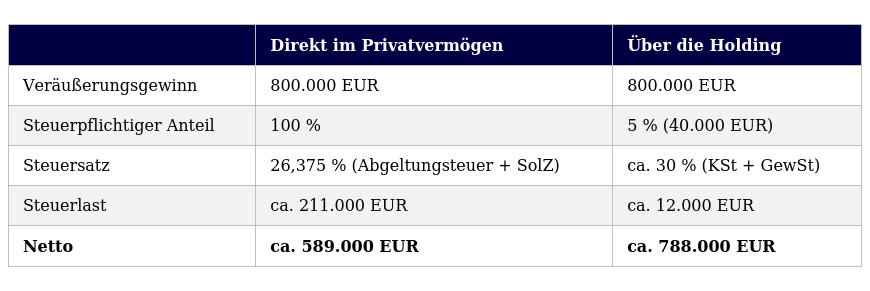
Assumptions: top tax rate of 45% plus solidarity surcharge of 5.5%, or flat-rate withholding tax (Abgeltungsteuer) of 26.375% for assets held privately; trade tax multiplier of 400% at holding company level; church tax disregarded. This presupposes that the blocking period arising from the contribution has already expired or was observed from the outset.
The net amount initially remains in the holding company and is available there for reinvestment; where it is distributed on in full to the shareholders, the overall burden again approaches that of direct taxation.
Possible disadvantages
The typical disadvantages can be summarised as follows:
- Additional administrative effort caused by a further company (financial statements, tax returns, compliance).
- Running costs for bookkeeping, annual financial statements and advice.
- Commitment through blocking periods and structure: anyone using the contribution on a tax-neutral basis is bound for several years to certain holding and structural requirements; otherwise, later restructurings can lead to subsequent tax charges.
Which legal form is suitable for the holding company?
GmbH
The GmbH is suitable in particular where the focus is on shareholdings in corporations and the tax-favourable treatment of dividends and capital gains is to be used as fully as possible. Profits are to be reinvested primarily within the company, without the shareholders being permanently dependent on ongoing liquidity inflows from the company. At the same time, a comparatively simple, clearly structured legal form with an unambiguous separation of liability is preferred.
GmbH & Co. KG
A GmbH & Co. KG is advisable above all where more complex family or succession structures with differing allocations of profits and voting rights are to be mapped out and certain tax effects are to be used directly at shareholder level. At the same time, the greater complexity of the structure is accepted, coupled with a willingness to keep a close eye on the boundary to commercial activity where the KG is to remain asset-managing.
How does setting up a holding company work in practice?
The formation process can be outlined in several steps:
- 1. Analysis and definition of objectives: First, the existing stock of assets – in particular shareholdings, securities and property – is recorded in full, and the objectives of the structuring, such as reinvestment, sale, limitation of liability or succession, are then clearly worked out.
- 2. Choice of legal form and structure: In the next step the appropriate legal form for the holding company is determined, typically the decision between a pure GmbH and a GmbH & Co. KG, and on that basis the shareholding ratios, the family structure and any foundations to be included are defined.
- 3. Formation: The articles of association of the holding company are then drafted and notarially recorded, registration in the commercial register is arranged, tax registration is carried out and the necessary accounts are opened.
- 4. Contribution of assets: The existing assets – such as GmbH shares, securities portfolios or property – are then transferred to the holding company in a tax-structured manner; at the same time it is examined whether and in what form these contributions can be made on a tax-neutral basis or at least in a tax-optimised way.
- 5. Organisation & compliance: Finally, the holding company's bookkeeping, reporting and annual financial statements are organised, clear rules for distributions and withdrawals are laid down and – in particular in the case of an asset-managing KG – ongoing monitoring ensures that the relevant thresholds are observed.
What tax points require particular attention when setting up the holding company?
Choice of legal form and tax effects
The decision between a GmbH and a GmbH & Co. KG largely determines whether taxation takes place primarily at company level (GmbH) or transparently at shareholder level (partnership). The holding GmbH benefits from the extensive tax exemption of dividends and capital gains from corporations, whereas the GmbH & Co. KG can, in certain constellations, make use of preferential tax rates or other effects at the level of the shareholders.
Tax-neutral contribution and blocking period
The central question is whether the contribution of the existing GmbH shares to the holding company can be made at book values, so that the hidden reserves present are not taxed immediately. Reorganisation tax law makes the carrying over of book values subject to various requirements, in particular a blocking period running over several years: where the holding company shares received are sold within that period, or certain arrangements are made, retrospective taxation may arise. This blocking period must invariably be taken into account in later sales, partial sales or restructurings.
Valuation and contractual arrangements
For the contribution in kind of the GmbH shares to the holding company, a comprehensible valuation of the shares is necessary in order to reflect the shareholding ratios and tax issues (for example hidden contributions (verdeckte Einlagen), gift tax) properly. The contribution agreement should be drafted in a manner coordinated as between civil law and tax law (contribution reference date, consideration, compensatory payments where applicable, contribution to the capital reserve).
Loss carryforwards and § 8c KStG
Loss carryforwards (Verlustvorträge) of the operating GmbH are in principle preserved by the mere move to a holding structure, but may be jeopardised by later changes of shareholders (the key concept being a harmful acquisition of shares above the 50% threshold). Before any transaction, existing loss carryforwards, shareholding thresholds and possible protective instruments (for example the continuation-linked loss carryforward (fortführungsgebundener Verlustvortrag)) should therefore be carefully reviewed and documented.
Frequently Asked Questions


.avif)
No-obligation initial consultation